Using the Kahtoola Microspikes on a spring mountain outing. Photo: iRunFar/Meghan Hicks
Are you looking for more grip on your winter runs on snow and ice? Having the best winter running traction devices for the conditions will keep you upright and running confidently through the slippery conditions of a snowy winter.
Traction devices are removable and fit over your running shoes to provide additional traction during winter running, whether on snow or ice. The active portion of traction devices is a set of metal teeth, spikes, tips, or coiled wire found underfoot. Any of several materials connect those bits to a harness that wraps around your running shoe’s toe, heel, and sides to keep the business end in place. Whether you call such devices traction devices, ice cleats, running grips, or crampons, this guide will help you find the right option for your next winter run.
Modern traction devices for running are strong and secure enough to get up and down many snow slopes and light enough to fit into a pack when you no longer need them. To help you find the best traction device for winter running, our team took the most promising options out in all conditions, from daily runs on the snow-packed streets of Silverton, Colorado to snowy outings on high Colorado peaks in the springtime.
We used them to negotiate iced-over trails in the Grand Canyon, where a slip could have meant a long fall, and then stashed them in our packs once we descended past the snowline. Our team analyzed various traction devices for grip on a variety of surfaces, comfort, ease of use, and durability so that we can help you sort between the options easily.
The Black Diamond Distance Spike was the best overall traction device for various scenarios, and we turned to the Kahtoola Exospikes for runs over variable terrain. To learn more about running traction devices before buying, check out our thoughts on choosing the correct ones for your needs, our testing methodology, and our answers to frequently asked questions about these devices.
Best Winter Running Traction Devices
- Best Overall Winter Traction Running Device: Black Diamond Distance Spike
- Best Winter Traction Device for Bulkier Shoes: Kahtoola Microspikes Ghost
- Best Value Winter Traction Running Device: Yaktrax Pro
- Best Winter Traction Running Device for Mixed Snow, Ice, and Pavement: Kahtoola Exospikes
- Best Winter Traction Running Device for Mountain Running: Kahtoola Microspikes
- Best Winter Traction Running Device for Icy Roads: Kahtoola Nanospikes

Traction devices can make traveling across snow much safer and easier. Photo: iRunFar/Eszter Horanyi
Best Overall Winter Traction Running Device: Black Diamond Distance Spike ($120)
Actual Weight: 3.3 ounces (93 grams) each. (All weights are for traction device models compatible with U.S. men’s size 9 shoes.)
Pros:
- Excellent grip on multiple surfaces
- Very lightweight for what they do
- Easy on and easy off
- Secure fit
Cons:
- High price
- Annoyance of metal spikes on pavement
- Toecap is a tight fit for bulky shoes

The Black Diamond Distance Spike. All photos iRunFar/Bryon Powell unless otherwise noted.
When launched in late 2020, the Black Diamond Distance Spike instantly jumped to the top of the winter running traction device pantheon. It is a crampon-like, chain-and-metal-spike style of traction device, but it cuts the weight of earlier running crampons roughly in half without losing grip.
Where its predecessors used heavy elastomers and thick metal components, the Distance Spike moves to thinner metal, thinner elastomer, and a fabric toecap. The 14 spikes are 8 millimeters long and strategically placed under the toes and front of the heel to provide optimal traction on packed snow and ice. They also supplement traction in softer snow. The easy-on, easy-off design is welcome when using them with gloves or chilly fingers. These have now been our go-to choice for a few winters!
View the full Black Diamond Distance Spike review for more information.
Shop the Black Diamond Distance SpikeBest Winter Traction Device for Bulkier Shoes: Kahtoola Microspikes Ghost ($105)
Actual Weight: 3.4 ounces (96 grams) each
Pros:
- Fits over shoes with bulkier midsole/outsole combos
- Relatively easy on and off
Cons:
- Most expensive traction device on the list
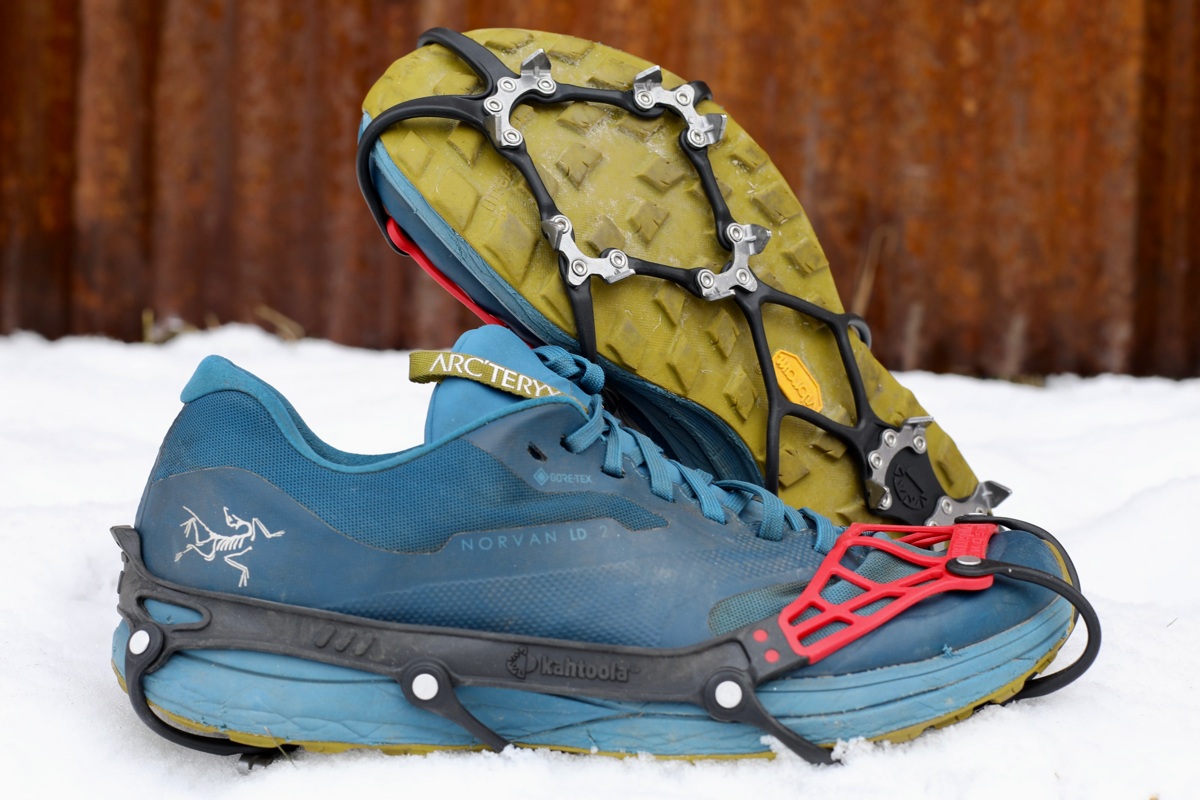
The Kahtoola Microspikes Ghost.
Truth be told, the Kahtoola Microspikes Ghost and Black Diamond Distance Spike are essentially tied for the top all-around winter traction device spot. While they slightly differ in details, these are highly comparable devices. Indeed, the Distance Spike doesn’t get its nod for its slightest of advantages on price and weight, but instead the author’s personal preference for the Distance Spike’s slightly greater comfort in the forefoot of road shoes. However, even that’s on the very margin. The Microspikes Ghost is a top-of-the-line, high-performance, relatively lightweight traction device.
The biggest reason to choose the Microspikes Ghosts over the Distance Spikes is if you wear the beefiest of midsole/outsole combinations — think Hoka Mafate X or The North Face Vectiv Pro 3 — for which we find the Microspikes Ghost a bit more accommodating.
For more details, read our full Kathoola Microspikes Ghost review.
Shop the Kahtoola Microspikes GhostBest Value Winter Traction Running Device: Yaktrax Pro ($30)
Actual Weight: 2.5 ounces (70 grams) each
Pros:
- Low cost
- Low weight
- Comfortable on stretches of bare pavement or trail
- Secure fit
Cons:
- Less traction on ice
- Not suitable for prolonged, burly off-trail adventures

The Yaktrax Pro.
The Yaktrax Pro is unlike any other traction device on the market, as its traction comes from metal wire coiled around an elastomer frame underfoot instead of spikes. The broad crossing pattern underfoot provides good traction on snow, while the metal coils provide some bite when running on packed snow or ice, albeit less than traction devices with actual teeth, spikes, or carbide tips.
That’s the downside, but the upside is that without metal teeth, spikes, or carbide tips, this is the most pleasant traction device for running on stretches of pavement or snow-free dirt. There’s no clicking, no odd high points underfoot, and no worry that you’re unnecessarily dulling your traction devices.
In addition, the small Velcro band across the top of the foot makes for a worry-free, secure fit. The level of performance that you get for the price of these traction devices makes them an excellent investment.
Bonus: Unlike most of the other traction devices in this guide, the Yaktrax Pro actually went down in price heading into the winter of 2025-26!
View the full YakTrax Pro review for more information.
Shop the Yaktrax ProBest Winter Traction Running Device for Mixed Snow, Ice, and Pavement: Kahtoola Exospikes ($75)
Actual Weight: 3.6 ounces (102 grams) each
Pros:
- Good all-around option
- Relatively light
- Very easy on and off
- Secure fit
Cons:
- Can feel a little unstable but plenty grippy on uneven ice

The Kahtoola Exospikes.
For some time, there’ve been traction devices that mounted carbide tips on flat panels that went under the outsole, but the Kahtoola Exospikes raised the game by putting the carbide tips atop 5-millimeter lugs (8 millimeters in total from the TPU base to the tip).
These devices are great for adding lug traction for running on snow and carbide-tip traction for running on ice to any road running shoes or trail running shoes with modest lugs. However, they start to feel awkward when used with trail running shoes that already have 5-millimeter or longer lugs. While the Yaktrax Pro reviewed above is an excellent option for road running, the Kahtoola Exospikes provide additional reassurance on ice.
View the full Kahtoola Exospikes review for more information.
Shop the Kahtoola ExospikesBest Winter Traction Running Device for Mountain Running: Kahtoola Microspikes ($85)
Actual Weight: 6.0 ounces (170 grams) each
Pros:
- Excellent traction
- Very secure fit
- Burly construction
Cons:
- On the heavier side
- Can slightly curl toes upward

The Kahtoola Microspikes.
One step down from true crampons, Kahtoola Microspikes are the burliest traction devices entirely fit for running. First launched over a decade ago, these were one of our first winter running traction devices. They worked great then, and with three incremental updates over the past decade, they continue to work great.
However, among all the strong traction device options today, these microspikes stand out for their bomber construction. Many of the iRunFar team regularly use these for running anywhere from the snowy streets of Silverton to the iced-up and snowy trails of the Grand Canyon, where a slip could be serious business. After years and years of using them, they are still on their first and only pair.
View the full Kahtoola Microspikes review for more information.
Shop the Kahtoola MicrospikesBest Winter Traction Running Device for Icy Roads: Kahtoola Nanospikes ($65)
Actual Weight: 3.7 ounces (105 grams) each
Pros:
- Low-profile studs don’t feel like overkill
- A flexible harness doesn’t create any hotspots
Cons:
- Not great on anything besides pavement
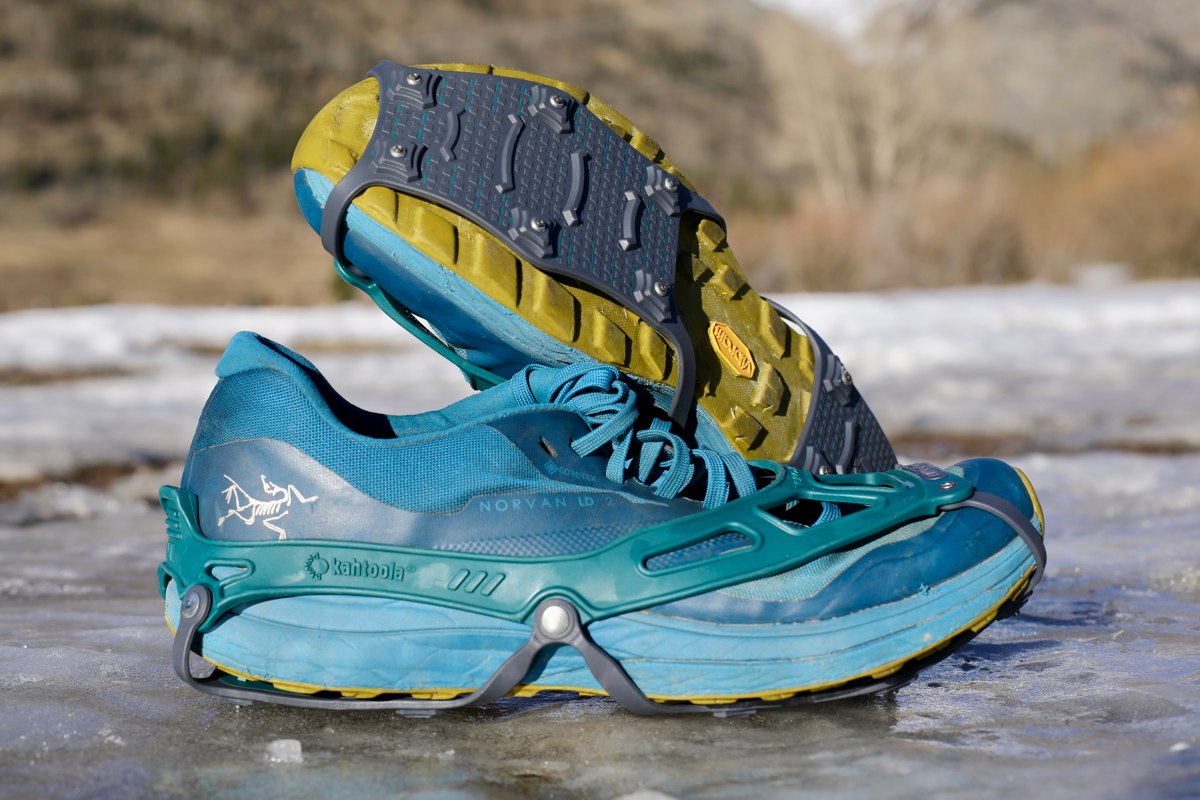
The Kahtoola Nanospikes.
Newly updated in 2023, the Kahtoola Nanospikes are an excellent option for running on flatter icy roads or paved paths when you don’t need 8-millimeter spikes to stay upright. The low-profile tungsten carbide studs on these are ideal for slick conditions without being overkill.
The spikes are concave instead of pointy, an upgrade from the previous version of these traction devices. The brand claims that this shape increases the pressure the spikes put on the ice and helps with engagement, and they’re also better at resisting abrasion when compared to the more common steel spike. The bottom plates of the devices have additional lugs to help with traction both going up and down hills.
The thermoplastic harness kept the device securely on our foot, which was especially noticeable while running downhill. We used these mostly with road shoes with soft uppers, and we didn’t experience any hotspots from the harness. The whole device is flexible and doesn’t cause excess foot fatigue.
These traction devices are light enough to carry by hand for short periods when they’re not needed, or they’ll slip easily into a pack if you’ve reached an area where the ice and snow have cleared up.
You can read more in our full Kahtoola Nanospikes review.
Shop the Kahtoola NanospikesComparing the Best Winter Running Traction Devices
| TRACTION DEVICE | PRICE | NUMBER OF SPIKES | SPIKE LENGTH | WEIGHT |
| Black Diamond Distance Spike | $120 | 14 | 8 millimeters | 3.3 ounces |
| Kahtoola Microspikes Ghost | $105 | 12 | 9 millimeters | 3.4 ounces |
| Yaktrax Pro | $30 | Coils | 1.4 millimeters | 2.5 ounces |
| Kahtoola Exospikes | $75 | 12 | 7.4 millimeters | 3.6 ounces |
| Kahtoola Microspikes | $85 | 12 | 9.5 millimeters | 6 ounces |
| Kahtoola Nanospikes | $65 | 10 | 5 millimeters | 3.7 ounces |
How to Choose Winter Running Traction Devices
Will you be running more on snow or ice?
To be honest, all the traction devices mentioned above will provide plenty of grip when running on snow. However, what you’re doing the rest of your time makes a difference in selecting a pair of traction devices.
If you’ll be mixing in sections of bare pavement or trail and you won’t encounter much ice, you’ll want to consider the Yaktrax Pro, as their lack of spikes, teeth, or carbide tips makes them more comfortable when running on stretches of harder surfaces. If you’re running on roads, flat trails, or paths that are more ice than snow, you might want to consider the carbide studs on the Kahtoola Nanospikes.
Running on ice is best done with traction devices with distinct teeth, spikes, or carbide tips. These devices are ideal because they concentrate pressure in a small area to bite into the ice. The Kahtoola Exospikes, with carbide tips, are an excellent option for terrain with some elevation gain and loss. That said, the Black Diamond Distance Spike, Kahtoola Microspikes Ghost, and Kahtoola Microspikes also perform excellently on ice.
Will you be running on pavement, concrete, or a bare trail?
If you’ll be running on significant sections of bare pavement, such as running a few miles to a trailhead or climbing on a bare trail up to the snowline, you might want a traction device that’s easy to get on and off, compact to store, but otherwise performs well on the snowy or icy surface on which you’ll eventually run. The Black Diamond Distance Spikes and Kahtoola Microspikes Ghost are both light enough to toss in a pack for the run to a snowy trailhead and easy to get on once you’re ready to use them.
If you run a mixture of patches of bare pavement, snow, and ice, and you don’t want to take your traction devices on and off endlessly, you might go with the Yaktrax Pro, which are more comfortable when running on bare ground than traction devices with teeth, spikes, or carbide tips. The Kahtoola Nanospikes have relatively low-profile carbide tips that perform well if you’re mainly running on icy roads.
Will you be running in dangerous or high-risk conditions?
Here, we’d recommend the Kahtoola Microspikes. They’re bomber, secure, and work in a mix of the burliest conditions. That said, you’ll likely get away with Black Diamond Distance Spike and Kahtoola Microspikes Ghost in most conditions.

A view of the roads and mountains of Silverton, Colorado, in winter with a variety of surfaces available.
Why Trust Us
iRunFar’s experts for this buyer’s guide live in the U.S.’s Intermountain West, which has long, snow-filled winters where running on snow and ice for months is the only option. We run on slushy shoulder season paths, packed snow trails, and glazed-over roads — where we tested these traction devices.
Unlike some product categories we’ve tested, there aren’t hundreds of legitimate options in the winter running traction devices space. At most, there are a couple of dozen options. As traction device models tend to last for many years with minimal modifications, a handful of the best options for winter running have emerged over the past decade.
We tested roughly a dozen of the top devices to determine in what conditions they excel. We’ve been running versions of some of these devices since at least 2007, meaning we’ve logged hundreds of hours in them from Virginia to Alaska and Colorado to California. We conducted our in-depth analysis mainly on the moderate-elevation, high-usage trails of Colorado’s Front Range and the burly, high-elevation roads of Silverton, Colorado.
Ultimately, we’ve identified what we think are the best winter running traction devices for various situations — we have these in our closets if we’re not out running in them.

iRunFar’s Meghan Hicks uses the Kahtoola Microspikes while crossing a steep snow slope in the San Juans of Colorado in spring conditions. Photo: iRunFar/Eszter Horanyi
Frequently Asked Questions About Winter Running and Traction Devices
Do I need traction devices for winter running?
Not necessarily. A good technique for the conditions — such as increasing the vertical aspect of your push-off while decreasing the horizontal aspect, increasing cadence, and avoiding sudden turns and stops when it’s slippery underfoot — can help keep you upright and under control, even without traction devices.
That said, the best winter running traction devices can provide reassurance, increase safety, and reduce the need to concentrate on footing. Carrying a backup traction device, such as the Black Diamond Distance Spike or Kahtoola Microspikes Ghost, can give you extra peace of mind when running in the winter. We’ve written more extensively on techniques for running on snow and ice.
Are there other names for winter running traction devices?
Yes. People sometimes call traction devices ice cleats, ice running cleats, snow cleats, traction cleats, running grips, ice traction devices, ice grippers, trail crampons, or even crampons, although the last more often refers to more technical mountaineering gear. The Yaktrax Pro, with its wire-coil design, deviates the furthest from what most people think of when they think of a winter traction device.
Are there any DIY solutions for adding traction for winter running?
A time-tested approach is the screw shoe, in which you screw several 3/8-inch or 1/2-inch hex-head screws into the lugs of each outsole. Setting up screw shoes will only take a trip to your local hardware store, a couple of bucks, and a few minutes of your time if you’ve got a drill handy. Note: If you’re interested in making screw shoes, you’ll want your shoe to have distinct lugs with a bit of depth to place the screw in.
Commercial options for the equivalent of screw shoes include the Icespike and La Sportiva AT Grip Hobnails. Unless you’re running exclusively on snow and ice throughout the winter, it’s arguably easier to have a pair of lightweight traction devices like the Yaktrax Pro to put on any pair of shoes you want to use instead of dedicating a single pair to winter running.

iRunFar’s Meghan Hicks crosses a snow slope during a traverse of the Wind River Range in Wyoming. Photo: iRunFar/Eszter Horanyi
Do I need special shoes for winter running?
While any running shoe can work for winter running, when there’s snow on the ground, and it’s not rock hard, trail running shoes with decent-sized lugs can add traction without needing traction devices. On the flip side, it can be annoying to wear most traction devices over deeply lugged trail shoes, as the combination of spikes and deep lugs can lead to a mishmash of very tall spikes and spikes recessed between deep lugs.
A whole category of running shoes has carbide tips embedded in the outsole. These generally provide outstanding traction on ice and can be pretty good on packed snow if they have some lug depth. The downside is that the metal tips can be annoying on bare pavement and wear down relatively quickly when used on hard surfaces frequently.
You’ll only want to wear these shoes on winter runs where traction will be an issue. You also won’t want to wear your spiked shoes into your house, stores, or, likely, even your car. Examples of running shoes with spikes include many models of Icebug running shoes, VJ Ace, and the La Sportiva Blizzard GTX, among others.
Shoes with waterproof membranes can also be great for shorter runs on ice or through an inch or two of snow. However, once you get into runs of an hour or two and longer, nearly all waterproof running shoes will become damp from sweat, if not from snow entering the ankle collar and melting. Although uncommon, the occasional winter running shoe has a water-resistant upper, which can be a nice compromise.
Even though membraned shoes will eventually get wet on the inside, they can help keep wet feet warm by reducing airflow through the shoe and holding in the heat generated by your feet. This makes them a viable choice for winter running for some people. Still, a membraned shoe is a very specific shoe for particular conditions.
Instead of having a dedicated winter running shoe, having one of the best winter running traction devices in your closet, such as the Black Diamond Distance Spike, can allow you to choose your shoe based on the conditions.

Winter running in mixed conditions. Photo: iRunFar/Meghan Hicks
How do I care for winter running traction devices?
Little needs to be done for these devices, as all metal components are made of stainless steel or another non-corroding metal. Still, it can’t hurt to shake them off and let them dry after an outing before storing them. For traction devices with elastomer portions, avoid leaving them in direct sunlight and hot temperatures to prolong their life.
While an uncommon situation for most of us, stretching the elastomer while below the rated temperature can also decrease its lifespan. The elastomers of our picks, especially the Kahtoola Microspikes, are durable and can withstand challenging conditions.
How do I choose between the available winter running traction devices?
Regarding performance, two primary considerations exist when choosing between the various traction devices intended for winter running.
First, consider what winter conditions you will most commonly be running in or, more importantly, on. Soft snow, hardpacked snow, and ice interact differently with traction devices. Toothed cleats tend to work well on all sorts of snow, while thin carbide tips, like on the Kahtoola Nanospikes, bite better into firm ice. Those carbide tips won’t add much traction in deeper snow but will add some purchase on hardpacked snow.
Second, consider how much ice-free and snow-free firm terrain you’ll run on, and whether that will be pavement or rocky trails, as the cleats and spikes of traction devices can be uncomfortable on such surfaces. You can mitigate this annoyance and possible discomfort if a traction device, such as the Yaktrax Pro, is easy to take on and off and store, provided there’s a relatively infrequent alternation between bare, hard ground and wintry conditions underfoot.
Other important considerations in choosing traction devices include price, durability, weight, and portability.

Traction devices are small and light enough to carry in a pack when you don’t need them for the entire run. Photo: iRunFar/Eszter Horanyi
Can I use winter running traction devices for technical mountaineering?
None of the traction devices above will fully substitute for a full crampon attached to a mountaineering boot, but many perform quite well on steeper terrain. The Kahtoola Microspikes are the closest option to a full crampon and grip well when snow slopes get steeper. The simple fact that running shoes aren’t as stiff as boots makes them less capable of kicking steps in hard snow, regardless of how burly an attached traction device is.
Running-focused traction devices also lack the front points of crampons, making them less adept at steep terrain. That said, most winter running traction devices will easily handle most of the terrain that runners take them on without a problem.
What about using traction devices for walking?
While all the traction devices we looked at would be suitable for both running and walking, check out this traction device roundup that’s more tuned toward walking and hiking if that’s your primary use. The Yaktrax Pro is a popular traction option for walkers.

While running at high elevations in the winter, runners may encounter hardpacked snow, ice, and steep slopes with a combination of the three. Photo: iRunFar
Other Winter Running Resources
Now that we’ve hopefully helped you stay upright, here are some additional resources for winter running.
- Finding Footing: Techniques for Running on Snow and Ice
- Embracing Winter: How Do You Do It? (Lots of good commentary from personal perspectives in the comments)
- Winter Training: Making This Your Most Effective Off-Season Yet
- Seasonal Affective Disorder and the Power of Positive Self-Talk
- iRunFar’s treadmill articles, with Treadmill Training: Welcome to the Machine being a good start
- Snowshoe Running Basics: The Why and How
- Snowshoe Racing
Fun Winter Running Reading
Finally, here are some entertaining stories about winter running.
- Why I Hate/Love Running in Winter – An amusing take on running through the winter
- What a Drag: Joe Grant’s Susitna 100 Experience – Joe Grant writes of his struggles pulling a sled with mandatory equipment for 100 miles in Alaska’s Susitna 100 Mile
- Geoff Roes’s 2012 Iditarod Trail Invitational (350-miles) Report – Geoff Roes’s blow-by-blow report of his 2012 Iditarod Trail Invitational run through the Alaskan winter
- David Johnston, 2014 Iditarod Trail Invitational 350-Mile Champion, Interview – An interview with David Johnston after his record-setting win (4 days, 1 hour, and 38 minutes) of this 350-mile race through Alaska’s winter wilderness
- Beautiful and Brutal: A 2018 White Mountains 100 Race Report – Bryon Powell shares the experience of running his first Alaskan winter 100 miler, the White Mountains 100 Mile, in 2018
Call for Comments
- What’s your favorite winter running traction device or devices?
- What winter running advice do you have?

A relatively flat road in Silverton, Colorado, surrounded by tall peaks.