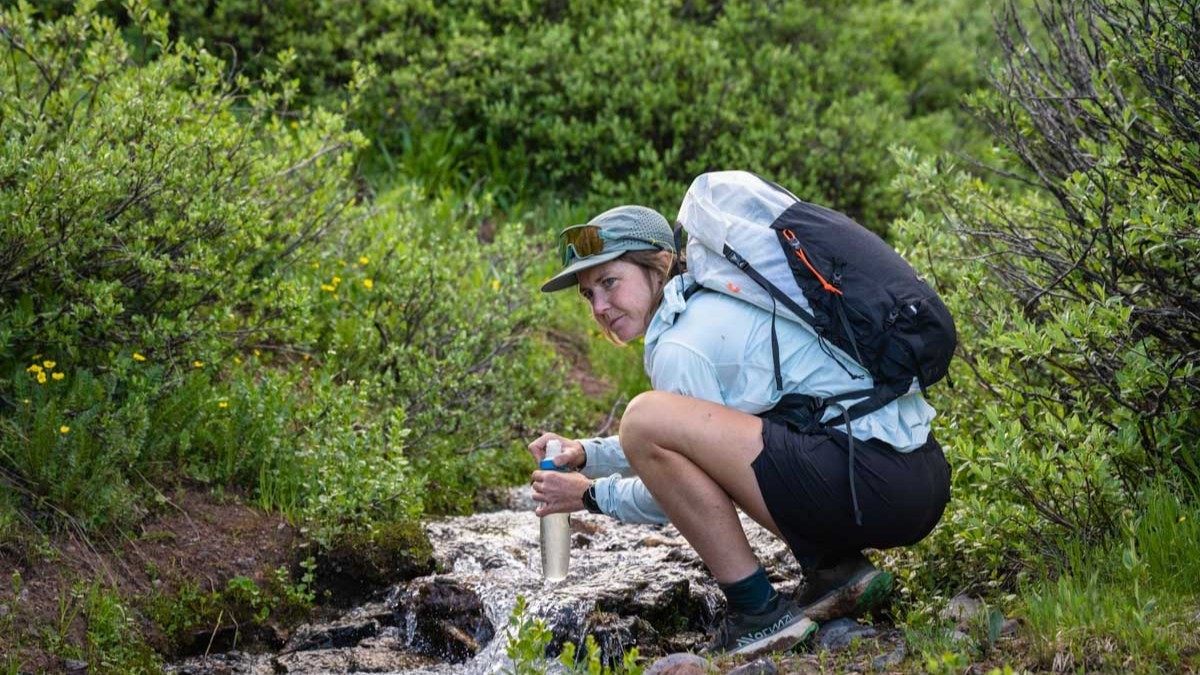
The best water filter for trail running will be effective, compact, and easy to carry. Photo: iRunFar/Eszter Horanyi
To remain hydrated all day while covering a lot of ground, many runners carry some form of water purification. We reviewed mostly water filters with built-in flasks because they are convenient for trail running — simply fill that soft flask and hit the trail. But we corralled a few other options for purifying large amounts of water or filtering into big bladders, too. Whether you’re running in the mountains or desert, 100 miles or 10, the best water filter for trail running will be the one that is easy to use and comfortable to carry.
Certain methods work best for clear-flowing mountain streams that we runners constantly seek, while other systems, or combinations of them, can purify even the most unappealing water sources — don’t worry, we’ll dive into the details. Regardless of the type of water you’re filtering, you want to be certain that it’s safe to drink. We judged water filters on their flow rates, ease of use, and how they fit in a running pack. We also considered the types of contaminants that they could remove from the water.
Our team continues to turn to the original Katadyn BeFree 0.6L for our backcountry water filtration needs, though there are now many new filters on the market that impressed us. When traveling in areas where we’re concerned about viruses in the water, we trust the SteriPen Ultralight UV Water Purifier to keep us safe and healthy. We also keep some Aquatabs 49mg Tablets in our running packs for emergencies.
To help you choose the best system for your needs, we researched the world of water purification and tested the best options for trail running. For more background information about water purification for trail running, see our glossary, buying advice, testing methodology, and frequently asked questions.
Best Water Filters for Trail Running
- Overall Best Water Filter for Trail Running: Katadyn BeFree 0.6L
- Overall Best Water Filter for Trail Running — Runner-Up: HydraPak 42mm Filter Cap
- Most Durable Water Filter for Trail Running: LifeStraw Peak Series Collapsible Squeeze 650 ml Bottle with Filter
- Most Comfortable Water Filter for Trail Running: Salomon Soft Flask XA Filter 490ml
- Best Water Purifier for Trail Running: SteriPen Ultralight UV Water Purifier
- Best Water Filter for Trail Running for Group Use: Platypus QuickDraw 1L Filter System
- Best Backup Water Treatment for Trail Running: Aquatabs 49mg Tablets
- Best Budget Water Filter for Trail Running: Sawyer Mini Water Filtration System

We named the Katadyn BeFree 0.6L the best overall filter for trail runners. Photo: iRunFar/Eszter Horanyi
Overall Best Water Filter for Trail Running: Katadyn BeFree 0.6L ($40)
Pros:
- Compact
- Lightweight
- Easy to use
Cons:
- The soft flask can spring leaks
There’s a good reason the Katadyn BeFree 0.6L is wildly popular among trail runners. It’s small, lightweight, compact, and reliable. It was also the original filter that fit directly onto a soft flask for ease of use on the trail. The filter weighs 35 grams on its own, and just 59 grams with the soft flask. The filter alone measures about 4.3 inches in length, including the lid. The soft flask is just slightly bigger than other 500- to 550-milliliter flasks and can be squeezed into hydration vest pockets, though it may feel a bit bulkier and floppier than flasks designed specifically for vests. Depending on your needs, this filter is available with both a 0.6- and one-liter flask. The filter can also fit on any HydraPak soft flask with standard 42mm threads, so you can use it with the one that fits your hydration vest the best. The filter can also be purchased without the flask.
This filter’s ease of use sets it apart from its competitors. To operate, unscrew and remove the lid (which is the filter) and fill the soft flask with water. Clear running water is generally the best option, if available. Then, screw the lid back on and drink through the water bottle mouthpiece! If you want to refill additional water containers, turn it upside down, and the water will flow on its own, or you can squeeze the soft flask to help push the water through the filter more quickly. A clear cover helps keep the mouthpiece free from accidental contamination.
It only takes a minute to filter two liters, though this flow rate will slow as silt and micro-debris clog the filter. The filter is easy to clean in the field if it becomes clogged, as no backwashing or extra tools are needed — just swish or shake the bottle with clean water. Although members of our team find backwashing occasionally to improve flow and lengthen time until replacement.
Like any filter, it can and will clog with use, even with regular swishing and cleaning. As the filter clogs, the flow rate will slow. When the flow becomes unbearably slow, it means it’s time to replace the filter — not because it’s less effective at removing contaminants, but because you don’t want to spend all day sitting next to a creek filtering water when your running companions are fully hydrated and ready to go. That said, with regular cleaning, these filters last long enough and work so well that we justify replacing them occasionally.
The soft flask that comes with the filter will get pinhole leaks if not treated with care. You can also buy just the filter part of this package if you already have soft flasks that it will fit.
To learn more, check out our in-depth Katadyn BeFree 0.6L review.
Shop the Katadyn BeFree 0.6L
The Katadyn BeFree 0.6L is our favorite filter for trail runners because it combines the ability to filter water with an easy-to-use soft flask. Photo: iRunFar/Meghan Hicks
Overall Best Water Filter for Trail Running — Runner-Up: HydraPak 42mm Filter Cap ($40)
 Pros:
Pros:
- Lightweight
- Easy to use
- High flow rate
Cons:
- It doesn’t come with a soft flask
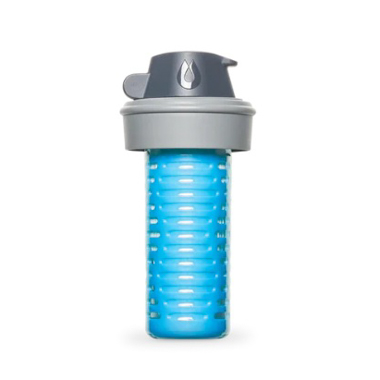
If you already own HydraPak soft flasks and want to avoid buying a filter that comes with one, you can get just the HydraPak 42mm Filter Cap.
The filter is easy to use: simply fill any HydraPak soft flask that has a 42-millimeter diameter opening with water, thread the filter on, and drink. You can also use this system to fill other water containers. With an initial filtration rate of over a liter per minute, you can filter a lot of water quickly, or you can sip directly from the filter with ease. The flow rate is high enough to keep our annoyance rate low. Sometimes, it even seems like the water isn’t going through the filter at all. But it is!
The 57-gram filter is light and on par with similar-style filters and will fit onto any HydraPak flask with a 42-millimeter diameter opening. The nozzle cover keeps water from leaking out and protects the mouthpiece from accidental contamination. We also appreciated the cover when we set the filter on the ground and while filling the flask.
Flow rates were nearly identical to the BeFree filter reviewed above in initial side-by-side tests. A pair of our iRunFar testers used these two filters about the same amount over the course of a summer. While the filters didn’t go on identical trips, their overall use was fairly similar. By the end of summer, the HydraPak was flowing just slightly better than the BeFree, but the difference was small enough that we couldn’t determine if it was due to variations in use or actual better performance. Either way, this filter performs up there with the best comparable options and is easy to clean by swishing it around in clean water.
Shop the HydraPak 42mm Filter CapMost Durable Water Filter for Trail Running: LifeStraw Peak Series Collapsible Squeeze 650 ml Bottle with Filter ($38)

Pros:
- High flow rate
- A removable filter enhances packability
- The filter is compatible with other LifeStraw Peak Series systems
Cons:
- Relatively heavy
- Nearly opaque soft flask obscures water amount
With a similar design and operation to our other top soft-flask filter choices, the LifeStraw Peak Series Collapsible Squeeze 650 ml Bottle with Filter falls only slightly behind for many users, as it’s slightly heavier and bulkier at 102 grams. The filter and lid together are 5.1 inches in length, so it will still fit easily into a hydration vest, but it’s not the most compact option available. That said, the filter can be unscrewed and removed from the lid, making the whole system more packable if you’re tight on space.
The bottle material feels thicker than comparable soft flasks, which indicates that it’s durable — yet it still packs down to about the size of a fist.
Because the 650-milliliter soft flask is dark, it’s tricky to see how much water you have unless you hold it up to the light. If you tuck your bottle into a hydration vest pocket, it may not be apparent when you’re running low on water. However, because of the bottle’s size and shape and the fact that it doesn’t fit into most hydration vest pockets super well, trail runners will be more likely to use this filter and bottle to refill other water bottles or while drinking at a water source. In this case, its high flow rate and ease of use make it a great choice.
Read more in our in-depth LifeStraw Peak Series Collapsible Squeeze 650 ml Bottle with Filter review.
Shop the LifeStraw Peak Series Collapsible Squeeze 650ml Bottle with FilterMost Comfortable Water Filter for Trail Running: Salomon Soft Flask XA Filter 490ml ($60)

Pros:
- Compact
- Lightweight
- High flow rate
Cons:
- More expensive
- Smaller capacity
- No protective cover for the nozzle
- You have to manually squeeze the mouthpiece to filter water into another container, risking contamination
Although it has some limitations, the Salomon Soft Flask XA Filter 490ml is an excellent water filter for trail runners. At 57 grams, it’s marginally lighter than the Katadyn BeFree 0.6L, but its soft flask holds only 490 milliliters rather than 600 milliliters of liquid. Its long cylindrical shape is designed to fit Salomon vests and will slide into the front pocket of most hydration vests. The cap and filter combination should fit any HydraPak soft flask with a 42-millimeter opening (and most other soft flasks with that size opening).
The plastic loop on the cap makes it easier to hold while filling it up and putting the lid back on. To operate the filter, simply fill the soft flask with water and drink directly from the mouthpiece. To filter water into another container, squeeze the mouthpiece and the flask at the same time. The filter has a high flow rate, which makes the whole process quick. Of all the filter nozzles, this one most closely mimicked a normal soft-flask mouthpiece.
The only real downside of this filter is that, unlike most other filters in this guide, the nozzle has no cover to protect it from being splashed by contaminated water. Additionally, you must place your potentially dirty fingers on the mouthpiece if you want to refill additional water bottles. This adds a risk of contamination unless you disinfect your hands first. That said, it’s the easiest to drink out of since there’s no lid to remove and, importantly, some users may find its soft bite valve more comfortable to use.
Shop the Salomon Soft Flask XA FilterBest Water Purifier for Trail Running: SteriPen Ultralight UV Water Purifier ($110)
Pros:
- Great for travel since it works against both bacteria and viruses
- Rechargeable
- Fast
Cons:
- Requires clear water to be effective
- It is more fragile than other types of filters
- Won’t work for soft flasks with small openings
- Expensive
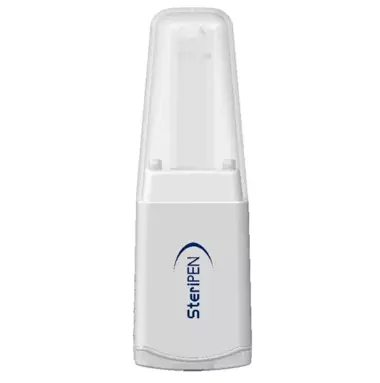
Water filters are a common solution for removing bacteria, protozoa, and sediment from water, but a purifier like the SteriPen Ultralight UV Water Purifier will also be effective against viruses, which are generally too small for a normal filter to remove. It does so by using ultraviolet light to scramble the DNA of microorganisms in the water so that they cannot reproduce if they end up in your digestive system, which is how they make you sick. This device is reasonably light and compact at just 76 grams and measures 5.1 inches in length. It’s comparable in size to a granola bar you might carry in your hydration vest. It’s also fast enough, as it can treat one liter of water in 90 seconds. It doesn’t remove sediment or other floaties from the water, so you’ll probably want to pre-filter your water if there is sediment or organic matter in it.
This device is simple and easy to use. Simply dip it into your water vessel so that the two metal sensors are submerged, then stir it slowly until the blinking green light turns solid green. The purifier will blink red and green when the battery is getting low, and since it’s rechargeable, all you need to do is plug it in before your next run so that it’s fully charged. A single charge will treat up to 20 liters of water, and the device will hold its charge for months.
This water purifier does have a few key limitations. For one, it requires clear water to be effective. This probably isn’t an issue if you’re running in the mountains — however, if your water source is cloudy or murky, you’ll need to pre-filter the water. In addition, since it’s essentially a small lamp, you’ll want to be careful not to drop it — it will break more easily than other purifiers. It also won’t work with small water bottles that don’t have a wide enough opening to allow stirring. Instead, this is ideal for individuals using a one-liter bladder or a hard-sided water bottle with a wide opening. Finally, it does not have a USB-C port, so you will need another cord to charge it.
Shop the SteriPen Ultralight UV Water PurifierBest Water Filter for Trail Running for Group Use: Platypus QuickDraw 1L Filter System ($55)

Pros:
- Ultra-fast flow rate
- Durable
- Ideal for group use
Cons:
- Relatively heavy
- Multiple parts
- A water storage bag is not a practical drinking vessel while running
If you’re trail running with friends and want to carry one filter for the group, we recommend the Platypus QuickDraw 1L Filter System. It features a sturdy one-liter water bag that rolls up fairly small and a separate hollow fiber filter enclosed in a protective case. Fill the bag from your nearest water source, attach the filter, turn it upside down, and squeeze the bag to help the water flow through the filter and into your water bottles or hydration reservoir. Be careful not to lose the small protective caps during the refilling process. Although it’s also possible to drink directly from the filter, this would not be practical while trail running since the water bag holds a full liter and would be cumbersome to carry by hand.
The high flow rate of 20 seconds per liter makes this an excellent choice when you have to filter a lot of water at once. At 95 grams, it’s not the lightest system, though it’s not heavy by any stretch, and its multiple parts break down so you can share the weight among a group. When using this system, you’ll also have to carry a second bottle that is easier to drink from while running.
While it’s not the most compact or ultralight option available, the main draw of this system is its speedy filter rate — you can easily refill everyone’s bottles and reservoirs in minutes.
Shop the Platypus QuickDraw 1L Filter SystemBest Backup Water Treatment for Trail Running: Aquatabs 49mg Tablets ($15)

Pros:
- Lightweight and packable
- It doesn’t alter the taste of water
- Effective against viruses
Cons:
- Requires a 30-minute wait before drinking
- It doesn’t filter out sediment
- Not effective against Cryptosporidium
While plenty of great water filters and purifiers are available, carrying a chemical backup option like the Aquatabs 49mg Tablets is always a good idea. These inexpensive tablets, which use sodium dichloroisocyanurate as the active ingredient, come in packs of 30 ($11), 50, or 100, and a single tablet can treat up to 64 ounces (1.89 liters) of clear water. A single tablet can also treat half as much cloudy water, though heavily sedimented water should be pre-filtered, even if only with a shirt or bandana in a pinch. Unlike other chemical water treatments, such as iodine, these tablets don’t change the taste or color of the water. Even if you’re not planning on picking up extra water on your run, it’s not a bad idea to carry a few of these tablets whenever you head out, just in case something goes wrong and you need extra drinking water.
These tablets are effective against bacteria, protozoa, and, unlike the filters in this guide, viruses. The only exception is the protozoan cryptosporidium — you’d need a filter or additional treatment to inactivate it. This treatment method won’t remove dirt or other debris, so it’s better for use with clear water. Finally, the tablets take about 30 minutes to purify your water, so if you use this method while trail running, you’ll want to set a timer before sipping.
Shop the Aquatabs 49mg TabletsBest Budget Water Filter for Trail Running: Sawyer Mini Water Filtration System ($37 for two)

Pros:
- Easy to use
- Compact
- Ultra-lightweight
Cons:
- Multiple parts
- A water storage bag is not a practical drinking vessel while running
We love the Sawyer Mini Water Filtraton System for trail running because it’s inexpensive and ultra-lightweight. With a field weight of just 57 grams, it’s on par with the lightest filters in this guide. It’s also the least expensive, and at one point, it was probably one of the most popular water filtration systems among trail runners. Even with many other options, this filtration system remains a favorite for trail runners and thru-hikers because it can be cleaned by backflushing the filter using the included syringe. This makes it last longer than many of the filters that attach directly to soft flasks and don’t have a mechanical backwashing option, although this can be done reasonably well by simply blowing back through a filter.
This system comes with a lightweight 16-ounce water bag and a small filter that measures 5.3 inches in length. To use, simply fill the bag with water, screw the filter onto the opening, turn the system upside down, and squeeze the bag. The bag has a small opening and can be difficult to fill with water, especially if you’re trying to fill it from a lake or other body of standing water. Patience is key, and some people will carry a second small container to scoop water into the bag. Once the filter is attached to the bag, the filtered water will flow into your water bottle, reservoir, or mouth. While the system is straightforward, the bag also contains step-by-step instructions in case you forget.
You can also use this filter in-line with a bladder. If you prefer to carry a bladder instead of soft flasks when you run, this is a great filtration option, as you can simply fill up your bladder with the filter attached to the hose and keep running.
Shop the Sawyer Mini Water Filtration System
Testing the LifeStraw Peak Series Collapsible Squeeze 650 ml Bottle with Filter in some spring runoff in Colorado. Photo: iRunFar/Eszter Horanyi
Comparing the Best Water Filters for Trail Running
| WATER FILTER | PRICE | CAPACITY | WEIGHT |
| Katadyn BeFree 0.6L | $40 | 600 milliliters | 2.1 ounces (59 grams) |
| HydraPak 42mm Filter Cap | $40 | N/A | 2 ounces (57 grams) |
| LifeStraw Peak Series Collapsible Squeeze 650 ml Bottle with Filter | $38 | 650 milliliters | 3.2 ounces (91 grams) |
| Salomon Soft Flask XA Filter 490ml | $60 | 490 milliliters | 2 ounces (57 grams) |
| SteriPen Ultralight UV Water Purifier | $110 | N/A | 2.7 ounces (77 grams) |
| Platypus QuickDraw 1L Filter System | $55 | 1 liter | 3.3 ounces (94 grams) |
| Aquatabs 49mg Tablets | $15 | N/A | Negligible |
| Sawyer Mini Water Filtration System | $37 for two | 490 milliliters | 2 ounces (57 grams) |
Water Purification Glossary
Water Filter: A sieve for particles in the water that effectively removes bacteria, protozoa, microplastics, sediment, and other particulate matter.
Water Purifier: A system using filtration, ultraviolet light, or chemicals to remove or inactivate all three classes of microbes: protozoa, bacteria, and viruses. Filter purifiers additionally remove microplastics, sediment, and other particulate matter.
Sodium Dichloroisocyanurate: A colorless, water-soluble chemical comprised of sodium, chlorine, carbon, nitrogen, oxygen, and hydrogen. It is a disinfectant and the active ingredient in Aquatabs 49mg Tablets. It is effective against the Giardia parasite but not Cryptosporidium.
Bacteria: Microscopic single-celled organisms found almost everywhere. While bacteria are vital to the planet’s ecosystems, certain types are harmful or deadly to humans. Escherichia coli (E. coli), Campylobacter jejuni, and Salmonella are harmful bacteria that can be found in water.
Protozoa: Single-celled organisms that can be free-living or parasitic and exist in most habitats worldwide. Giardia lamblia and Cryptosporidium are two parasitic protozoa found in water that can harm humans.
Virus: Waterborne viruses that infect humans often come from human and animal feces in the water. The two most common waterborne viruses in North America are the rotavirus and the norovirus, which cause fever, vomiting, and diarrhea and are relatively rare in backcountry waters. In other parts of the world, other types of viruses may be more common in the water.
Cryptosporidium: A microscopic parasite found in water that causes the diarrheal disease cryptosporidiosis. Due to its outer shell, “crypto” can survive for long periods outside a host body and tolerate chlorine disinfection.
How to Choose a Water Filter for Trail Running
Water Purification: Filtering Versus Purification
A water filter is essentially a strainer with microscopic pores that removes sediment, microplastics, and microbes such as bacteria and protozoa from water. The smaller a water filter’s pore size, the more matter it will remove from the water. When choosing the best water filter for trail running, you’ll want to select one with a pore size of either 0.1 or 0.2 micrometers.
Eventually, a water filter’s pores will become clogged, and the filter will need to be cleaned or replaced. Our testers’ favorite water filter for trail runners is the Katadyn BeFree 0.6L because of its low weight and ease of use. The HydraPak 42mm Filter Cap came in with a close second.

We loved the Katadyn BeFree 0.6L because of its light weight and portability, including in running vests. Photo: iRunFar/Eszter Horanyi
Because viruses are so tiny, they can move through most filters and must be deactivated by chemicals, UV light, or fancy filters too heavy for our list. Water purification systems must meet federal standards for the inactivation of all three classes of microbes: protozoa, bacteria, and viruses. The SteriPen Ultralight UV Water Purifier uses ultraviolet light to purify water. Chemical purification methods, such as iodine, chlorine, or chlorine dioxide, are also common.
For trail runners, a water filter will be sufficient for most scenarios. However, if you’re running in an area where waterborne viruses are a risk, or you want added confidence in the safety of your drinking water, you could filter water and then treat it with one of the purification methods listed above, either chemical or UV.
Water Filter Pore Size
Water filters have microscopic pores that stop nearly all particles. Bacteria and protozoa will get caught in the filter’s fibers, while viruses are small enough to fit through even the smallest pores found in most filters. As a general rule, the smaller the pore size, the more the filter will catch and eliminate from your drinking water. That said, smaller pores can also clog more quickly, requiring more frequent cleaning or filter replacement. Filtering from the cleanest possible water sources will help prolong the life of your filter, although that’s not always possible. Regular cleaning, whether using the swishing method for the Katadyn BeFree 0.6L and the Salomon Soft Flask XA Filter 490ml or backflushing the Sawyer Mini Water Filtration System, will also extend the lifespan of your water filter.

Whether you’re getting water from a desert cow trough or a high alpine lake, it’s always a good idea to filter it. Photo: iRunFar/Eszter Horanyi
All of the filters on our list have pore sizes of 0.1 or 0.2 micrometers. A micrometer, often abbreviated as a micron, is one-millionth of a meter. There are 1,000 micrometers in a millimeter and 10,000 micrometers in a centimeter. For reference, the smallest objects visible to the naked eye are 40 to 50 micrometers.
So, yeah, these water filter pores are tiny! Small enough, in fact, to catch 99.9999% of bacteria and 99.99% of protozoa, the primary pathogens in wild water. Water filters will have their efficacy rates printed on their packaging. If you’re concerned about viruses in water where you’ll be running, an additional purification method, such as Aquatabs 49mg Tablets, will inactivate viruses.
Backwashing and Cleaning a Water Filter
Water filters require periodic cleaning to maintain a high flow rate. Some filters, such as the LifeStraw Peak Series Collapsible Squeeze 650 ml Bottle with Filter and the Sawyer Mini Water Filtration System, come with a syringe for backwashing. Cleaning a filter regularly will help maintain its flow rate and extend its lifespan.
For other filters, like the Platypus QuickDraw 1L Filter System, there are two methods for cleaning the filter that don’t require a syringe: shaking or backwashing. The Katadyn BeFree 0.6L can be easily cleaned at home or in the field by shaking the bottle or swishing around the filter in clear water. To avoid contamination when cleaning, be sure to swish only the filter fibers in the creek, not the part that you drink from. You can also backwash or backflush any water filter by blowing backward into a filter that has water in it.
It’s important to note that filters and the cartridges housing them are delicate, and cleaning them improperly can cause permanent damage. For best results, we recommend following the cleaning instructions included in the user manual.

iRunFar’s Meghan Hicks uses the HydraPak 42mm Filter Cap attached to a HydraPak Ultraflask to filter water out of a desert pothole. Photo: iRunFar/Eszter Horanyi
For the best water filter storage and care, follow the manufacturer’s instructions for your specific filter. Before storing your filter long-term, clean it and allow it to dry completely. Store your filter away from direct sunlight and in a location where it won’t freeze. Freezing can damage the fibers, potentially letting pathogens through upon the next use.
LifeStraw recommends storing the LifeStraw Peak Series Collapsible Squeeze 650 ml Bottle with Filter in a saline solution made by mixing salt with water. The solution helps maintain the filter membrane’s hydrophilic properties while preventing mold and algae growth.
Why You Should Trust Us
The iRunFar team is composed of road runners, trail runners, and ultrarunners with a collective 150-plus years of running experience. Several team members have been traveling in the backcountry and using different water purification methods for over two decades.
We started this buyer’s guide with a deep dive into the water purification and treatment marketplace. The team weighed in on the options, considering their experience and preferences with water purification methodology, and we narrowed our choices to a list of what we suspected would be the best water filters for trail running.
From there, author Alli Hartz took our top choices into the field, where she tested them while running. Because this testing period overlapped with her trip to Ecuador, Alli tested a few of the filters in the waters near Quito and Cotopaxi National Park. Alli tested the rest of the filters along her home trails in central Oregon. We have since updated this guide with updated products and additional testing insights, including tests in the Rocky Mountains and the American Southwest. Some of our team members have more than five years of experience with several of the filters in this guide.
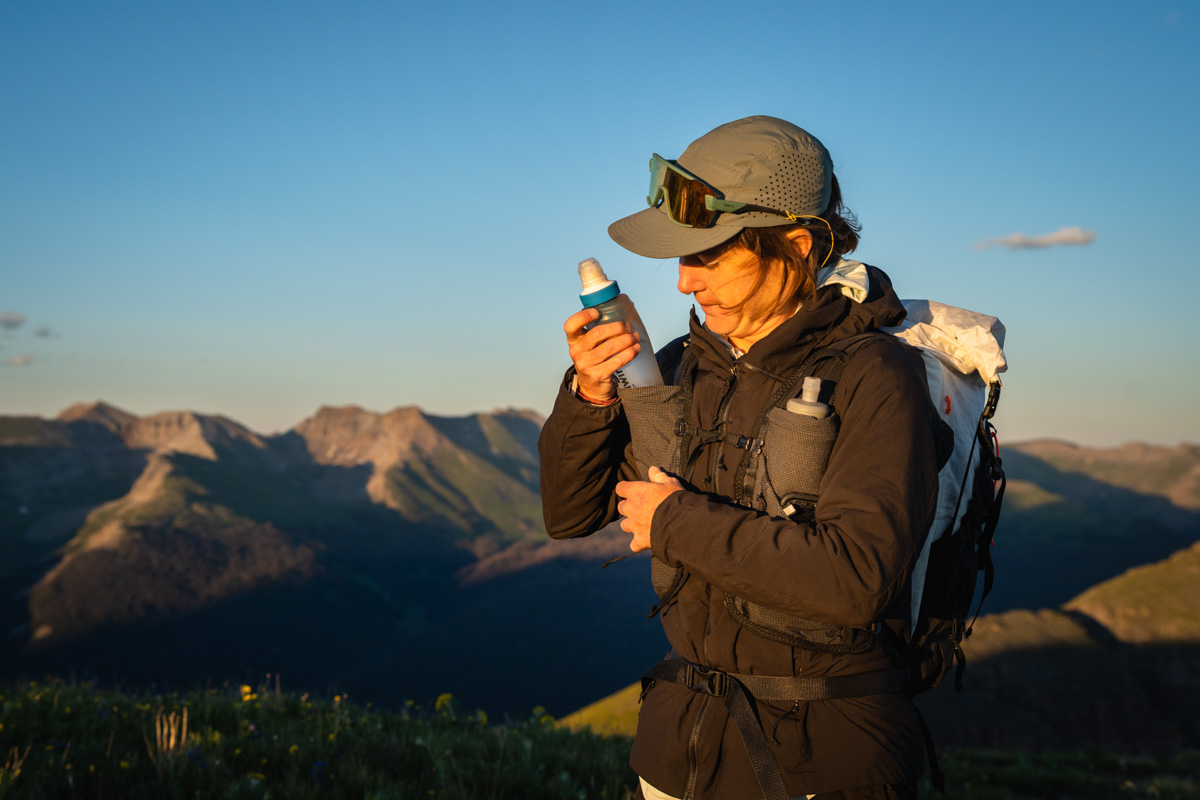
We tested several different water filters in a variety of settings. Photo: iRunFar/Eszter Horanyi
Frequently Asked Questions About Water Purification for Trail Running
Why do you need purified water while trail running?
Some nasty types of bacteria, protozoa, and other organisms in lakes, rivers, streams, cow tanks, and puddles can be harmful and even deadly to humans. The most common risk from drinking untreated water is some sort of bacterial or viral infection that will make you very sick — causing diarrhea, vomiting, headaches, or fever — which is certainly not a fun post-running experience and can lead to even less fun things like going to the hospital, experiencing long-term health effects, or dying.
While those cascading mountain streams and turquoise alpine lakes may appear innocuous, the fact is that any water source can contain microscopic organisms that can make humans very sick. Purifying water before drinking eliminates nearly all harmful pathogens and significantly reduces the risk of illness. Plus, water filters will catch dirt, tiny bits of organic matter, and other particulates, so your water tastes as pure as that mountain stream looks. And when the best water filters for trail running options are as light, fast, and easy to use as the Katadyn BeFree 0.6L or the HydraPak 42mm Filter Cap, there’s no reason not to carry one.
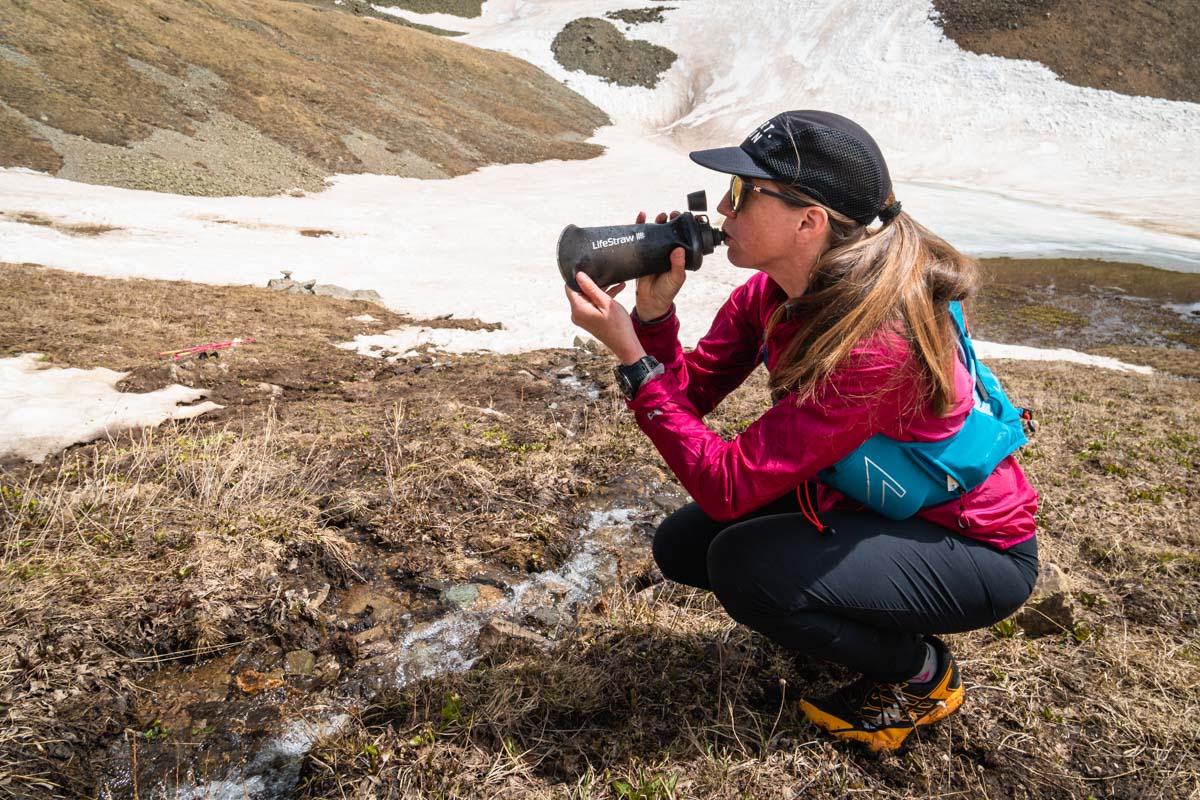
Meghan Hicks of iRunFar tests the LifeStraw Peak Series Collapsible Squeeze 650 ml Bottle with Filter on a spring mountain run. Photo: iRunFar/Eszter Horanyi
What type of water purifier is best for trail running?
The best water cleaning system for trail runners is lightweight, compact, effective, easy to use, and quick. Filtration, chemical treatment, or UV light treatment are all excellent purification methods for runners. During long days on the trail, stopping to filter water can gobble up precious time — so we recommend a water filter or purifier that’s easy to access, quick to deploy, and fast to use.
Filters that attach directly to a soft flask, like the Katadyn BeFree 0.6L or the Salomon Soft Flask XA Filter 490ml, are quick and effective because all you have to do is fill up your flask from a water source, screw on the filter cap, and keep going, drinking directly from the filter mouthpiece as you run.
For runners who prefer to run with a hydration bladder, the Sawyer Mini Water Filtration System may be a good option, because it’s quite lightweight and is compatible with a hydration bladder hose.
Or, if you know you’ll be near clear water, you may opt for the lightweight, small, and quick SteriPen Ultralight UV Water Purifier. The SteriPen is also a great option if you’re traveling in an area where waterborne viruses are more common.
When choosing the best water filtration or purification system, consider how you prefer to drink water on the trail. Do you like smaller soft flasks or a bladder with a hose? Next, consider the most comfortable and convenient ways of carrying the filter or purifier. From there, you can choose the tool that seems easy and intuitive to you.
While all the filters or purifiers on this list are relatively easy to use, some have more parts or require more steps. If you’re notorious for misplacing small components, opt for one that doesn’t have detachable parts. There are many good options for the best water filter for trail running, so once you’ve narrowed it down, go with your gut! (It will thank you.)
Do I have to filter all backcountry water?
Not all backcountry water has harmful bacteria— generally speaking, the more remote a water source, the less chance that it will have Giardia or other microbes that will make you sick. We’ve watched friends drink directly from manky desert potholes and suffer no ill effects, and we’ve also (accidentally) filtered water contaminated by mine waste and spent the night and the next day huddled next to the toilet. All this to say, drinking unfiltered wild water can be perfectly fine, and filtering water won’t always prevent a date with the porcelain throne.
Our team has consumed thousands of (mostly filtered) liters of wild water throughout the world, and still errs on the side of using filters all the time. When you have lightweight options like the Katadyn BeFree 0.6L or the Salomon Soft Flask XA Filter 490ml, it really feels like a no-brainer for us to gain that extra peace of mind when drinking wild water.
We recommend filtering everything you drink if there are cows or other domestic livestock around.
How safe are water filters for trail running?
Since water filters remove 99.9999% of bacteria and 99.99% of protozoa, they make water very safe to drink. Most filters, and none on this list, don’t effectively remove viruses. If you’re filtering water in an area with harmful viruses, then using a water purification device like the SteriPen Ultralight UV Water Purifier is a good idea.

Maggie Guterl carries a Katadyn BeFree 0.6L in a running vest pocket while tagging peaks in the Weminuche Wilderness of Colorado. Photo: iRunFar/Eszter Horanyi
What is the most effective water filter for trail running?
While there are no federal regulations for backcountry water filters, there are protocols and guidelines that filters should, and typically do, meet. You might find phrases like “meets NSF Protocol P231” and/or “the U.S. Environmental Protection Agency’s Guide Standard and Protocol for Testing Microbiological Purifiers” on the water filter’s informational materials.
In addition, you’ll likely see specific claims, such as “removes 99.9999% of bacteria and 99.99% of protozoa.” This type of language indicates that the water filter is appropriate for backcountry use. Other numbers worth paying attention to are the filter’s pore size, which should be 0.1 or 0.2 micrometers — small enough to filter out bacteria and protozoa. All the filters on our list meet these standards and are adequate and appropriate for trail running.
Aside from these minimum standards, the best water filter for trail running will be compact, comfortable to carry, easy to use, and durable. Pairing a water filter like the Salomon Soft Flask XA Filter 490ml with a water purification method like the SteriPen Ultralight UV Water Purifier will all but ensure that your water is safe to drink anywhere you run.
How much water should I carry on a trail run?
When planning for a long day on the trail and deciding how much water to carry, the weather and water access on your route are two of the biggest variables to consider. You’ll need more water on a hot, dry day than on a chilly or rainy day.
Carrying a liter or more of water can feel heavy while running, so if you know you’ll have access to plenty of water while out on the trail, it may be worth carrying less and planning to stop and filter more frequently. That said, filtering takes time and breaks up the flow of the run.
After weighing all these factors, it’s a good idea to err on the conservative side and carry a bit more water than you think you’ll need, as well as a filter in case you run out. The consequences of dehydration or drinking unfiltered water are much worse than the burden of carrying a few extra ounces in your vest. Having a sleeve of Aquatabs 49mg Tablets in your pack at all times can provide a safety backup in case something goes wrong and you run out of water unexpectedly.

The Katadyn BeFree 0.6L fits in most running vest pockets and is only slightly bulkier than a normal 550-milliliter soft flask. Photo: iRunFar/Eszter Horanyi
How do you know when it’s time to replace a water filter?
When the flow rate slows to an unbearable rate, it’s time to replace the filter. The longevity of your filter will depend primarily on the turbidity (cloudiness) of the water you’re filtering. High mountain streams? It might last a year. Colorado River? You’ll be lucky to get three months. Most water filters will advertise the number of liters they will filter over their lifespan, but in our testing, none of them reach that number before they start to clog and slow down.
However, don’t toss your filter just because the flow rate is decreasing — try cleaning or backwashing it first. Cleaning the filter of the Katadyn BeFree 0.6L regularly by swishing it around in clean water can keep it flowing efficiently for a long time. You’ll be surprised by the particles that come out when you swish it around in a glass of water! Refer to your filter’s user manual for the best cleaning method. If you’ve made some solid attempts at cleaning it and it’s still slow — and maybe you’ve been filtering some mucky water — then it may be time to consider replacing your filter. Depending on the model, you may be able to replace the filter cartridge rather than the entire system.
What happens if my water filter freezes?
Freezing will damage most water filters, especially if they’re wet, and can make them less effective. If you think your water filter is frozen, let it thaw before trying to use it to minimize the damage. Give your filter’s user manual a careful read to see how freezing could affect its performance. For most trail running situations, a frozen water filter is rarely going to be an issue, but if you’re fastpacking, you might want to sleep with your water filter in your sleeping bag if the night is going to get below freezing. If you’re concerned about your filter freezing, consider carrying it close to your core and bringing a backup purification method, such as Aquatabs 49mg Tablets.

Meghan Hicks of iRunFar carries a Katadyn BeFree 0.6L during a fastpacking trip in the San Juan Mountains of Colorado. Photo: iRunFar/Eszter Horanyi
How durable are the water filter flasks?
Most flasks that come with water filters are comparable to those made by regular running brands, and HydraPak makes many of them. They are made of TPU and can withstand the regular wear and tear of being in a running vest or fastpacking pack pocket, but they will spring leaks on occasion. Many of the filters included in this guide, including the Katadyn BeFree 0.6L, will screw onto any HydraPak soft flask if the original one gets damaged.
Call for Comments
We want to hear about your favorite water purifier for trail running! Leave a comment to share which filter or treatment system you love, and tell us in what conditions it performs best for you.
- Do you have a favorite water filtration or purification system that you use?
- Do you regularly filter water while you’re out on your runs?
Back to Our Top Water Filters Picks

The HydraPak 42mm Filter Cap filtered manky desert water over the course of a week-long trip and maintained decent flow rates. Photo: iRunFar/Eszter Horanyi